
How Might We Encourage Children to Read More?
It all begins with an idea.
Everything begins with an idea, and the goal of this project was to practice prototyping, experimenting, and iterating to move ideas forward. This was the second IDEO U course I completed, and it taught me to frame ideas as experiments, expanding my capacity for creativity, innovation, and structured exploration.
Phase 1: Ideate
Ideation is all about exploring possibilities. The focus for this phase was generating an abundance of ideas, pushing past the obvious, and embracing playful thinking. One of my biggest learnings was the value of quantity over quality early in the process because it allows room for the unexpected, the bold, and even the ridiculous.
Mindset: Be playful.
Step 1: Planning
To tackle the prompt “How might we encourage children to read more?” I designed a 30 minute ideation session and invited my partner to join via Zoom. I chose the mash up ideation method, which involves gathering elements or techniques from unrelated industries and cross pollinating them to spark fresh thinking.
Method: Mashup
Tools: Zoom and Miro
This approach helped us stretch our creative muscles and explore unconventional ways to inspire young readers.
Step 2: Ideate
We began with 15 minutes of individual brainstorming in Miro, listing features, products, and methods from industries we found interesting. We then used those components to cross pollinate ideas by combining unexpected elements and pushing beyond familiar solutions.
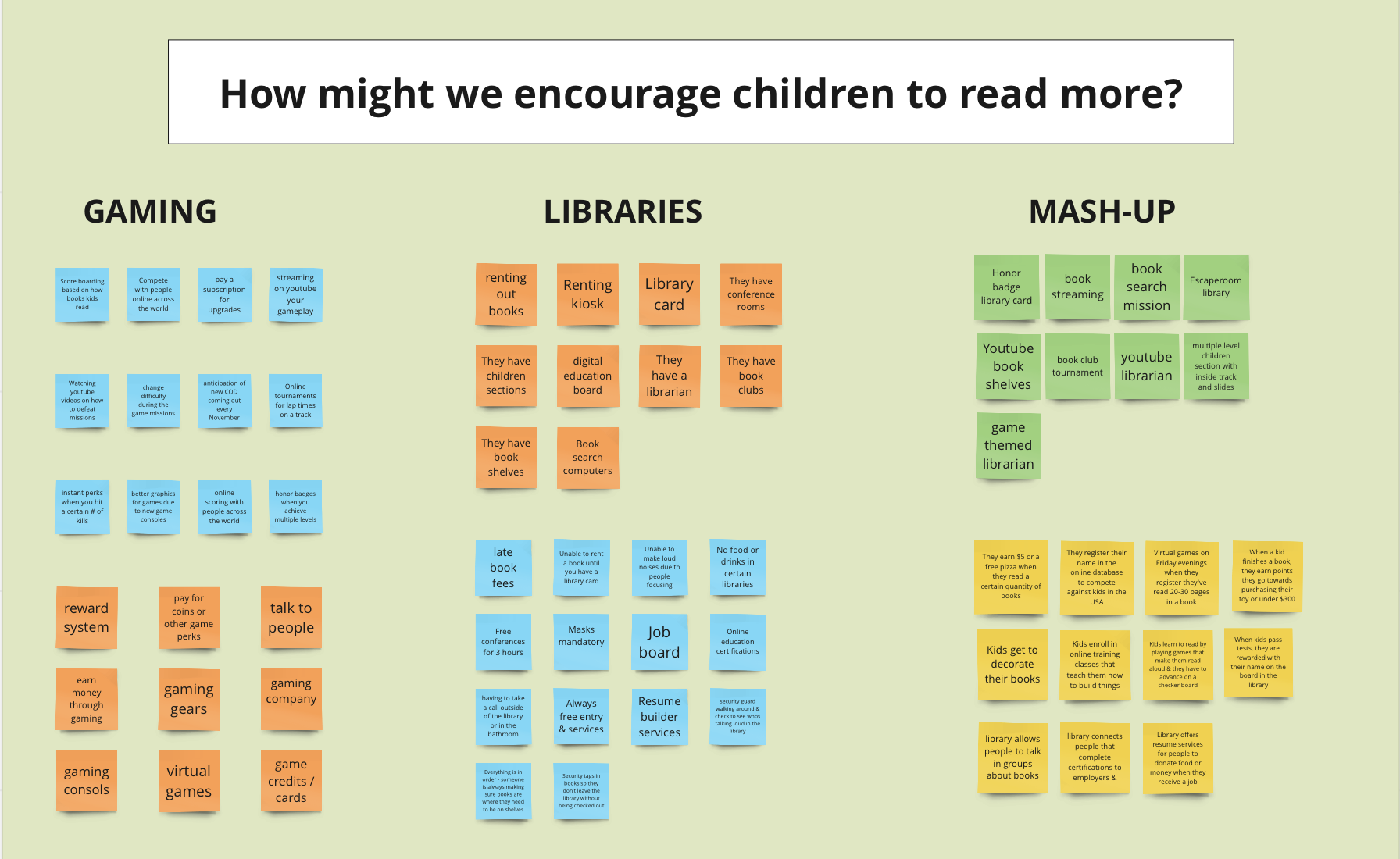
Project challenge: How might we encourage children to read more?
Method: Mashup
Tools used: Zoom and Miro
Step 3: Converge
By the end of the session, we generated a total of 20 ideas, more than we planned for. After sharing our concepts with each other, we voted on the strongest directions to move forward with. Three ideas stood out.
Key Ideas
Create a book with an integrated digital screen that visually animates content as the child reads aloud
Create book themed library escape rooms where kids solve puzzles inspired by stories they have read
Design reading based games where kids must read out loud to advance levels
Personal Reflection
Leading the ideation session was more challenging than I expected. I felt flustered at the beginning while trying to keep the session on track, but with patience, structure, and openness, it evolved into a productive and energizing experience.
Insight:
Preparation is essential for running ideation sessions because clear structure creates more room for creativity.

Phase 2: Prototype
It all begins with an idea.
Time to make ideas tangible.
Once I had selected the ideas to explore further, the next step was to turn them into something real. Prototyping allowed me to visualize the concept, share it with others, and gather feedback that helped refine the idea even more.
Mindset: Build to think.
I gathered cardboard and simple materials I had at home and spent one focused hour creating a rough prototype that captured the essence of the idea.
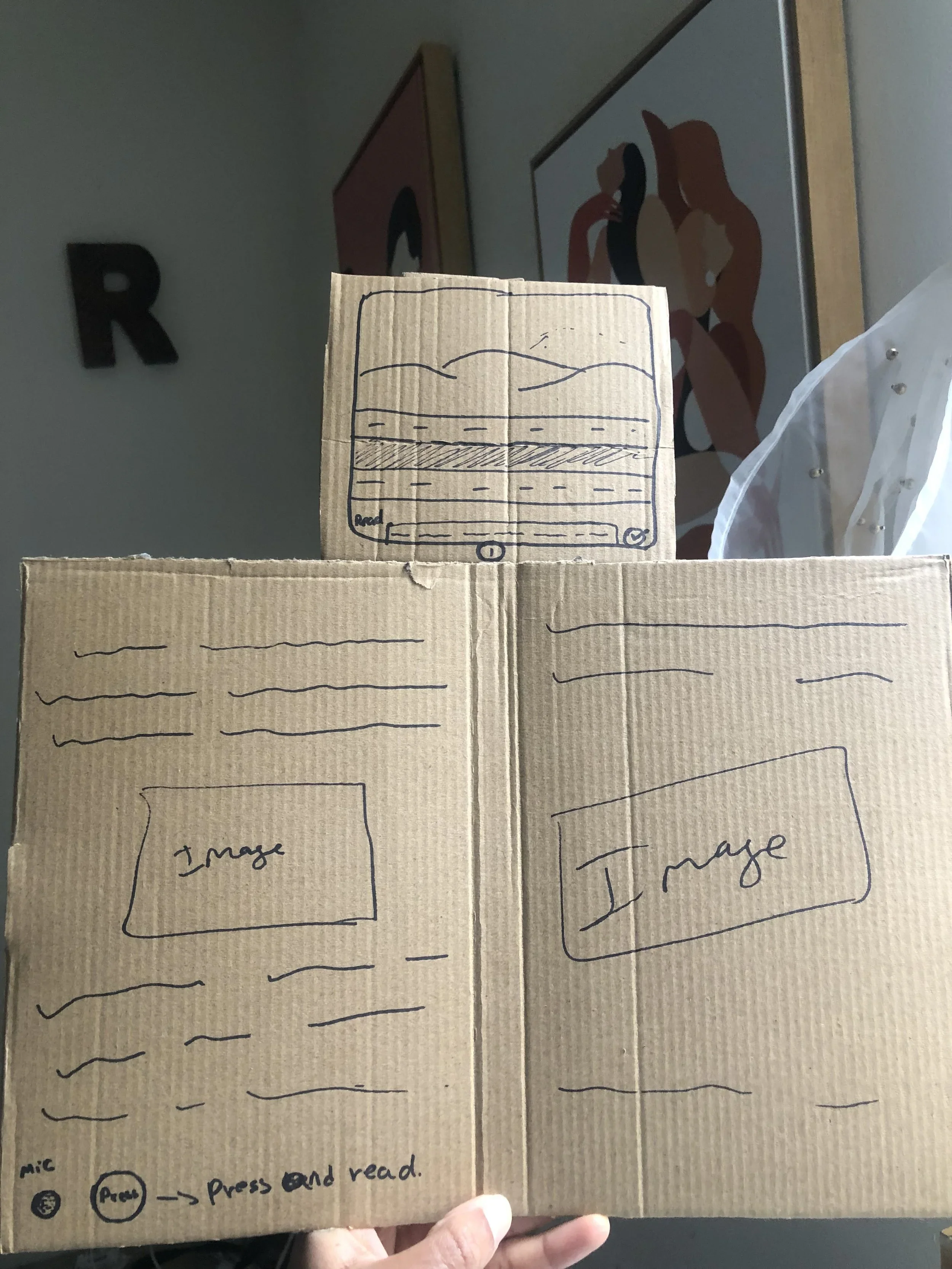
Prototype Concept
My initial concept was called Techno Read, an interactive reading tool that encourages kids to read aloud. As the child reads, the book would display an animation of the story on an attached screen. The idea also creates an opportunity for bonding between parents and children as they read together and watch the story come to life.
Step 2: Share the Prototype and Gather Feedback
I shared the prototype with my partner and walked him through the concept. I wanted to understand where the design might face challenges in terms of functionality, usability, and desirability. His feedback was insightful and immediately helped expand my thinking.
The first concern was weight. He asked if the book would be too heavy for children to carry if a screen were physically built into it. His second observation focused on flexibility and cost. Instead of embedding the device into a book, he suggested exploring ways to connect the book to a phone or tablet.
This led us to brainstorm a new version of the concept called Plug and Read, a tool that connects a book to any personal device. This eliminated the need for an installed screen and created a more affordable, adaptable solution.
Reflection
Prototyping revealed that the idea had promising potential and multiple directions it could grow. It highlighted the opportunity for kids to develop reading skills in a fun and interactive way while incorporating technology they already recognize.
I also became aware of new questions to investigate. How might we connect physical books to a device in a way that feels seamless and intuitive for kids? How might we support engagement while avoiding digital distractions? What format would offer the best experience, such as an app or a website?
The feedback allowed me to iterate on the concept and think more critically about usability, accessibility, and cost. Most importantly, it showed how valuable prototyping can be in shaping ideas and guiding the next phase of exploration.

Phase 3 : Iterate
Moving Ideas Forward
Iteration allowed me to revisit my ideas repeatedly through cycles of ideation and prototyping. This phase pushed me to narrow in on the core problem, remain open to feedback, and experiment my way forward.
Mindset: Experiment your way forward.
Share Your Prototype for Feedback
I began this phase by sharing my prototype with my partner and explaining the concept behind it. My goal was to understand potential challenges related to functionality and desirability. His feedback surfaced important considerations that helped the idea evolve.
The first challenge he identified was the weight of the book. He wondered whether a built-in screen would make the product too heavy for children to carry. His second question focused on flexibility and asked whether the concept could be an add-on to existing devices rather than embedded in a book.
This feedback led us into another brainstorm where we created a revised version of the idea called Plug and Read, a concept that allows any book to connect to a phone or tablet. This eliminated the need for an installed device within the book and opened up new opportunities for accessibility and cost effectiveness.
Reflection
This phase showed me that the idea was worth exploring and that it had many possible directions. I learned that technology can make reading more fun and interactive for children, but it also brought up new questions for the next iteration.
How might we connect a physical book to a device in a simple and intuitive way?
How might we avoid digital distractions while encouraging reading?
How might we design a tool that is easy to use, durable, and accessible?
The feedback I received helped me think critically about usability, affordability, and long-term product development. It also raised important questions about what format future iterations should take, such as an app, a device add-on, or a hybrid model.
Prioritizing Top Questions
To guide the iteration process, I used three design thinking lenses to develop questions that would move the concept forward.
Desirability: Understanding the user
What else do I need to understand about children and their needs as young readers?
How might we make the plug and read feature exciting enough for children to choose a book over a screen?
How might we encourage kids to keep reading even when they make mistakes?
Feasibility: Making the solution work
How might we connect a book to an external device such as a phone or tablet?
How might a microphone be incorporated into the experience?
How might we capture different diction and pronunciation accurately?
Viability: Ensuring long-term sustainability
How might we integrate a supportive reading assistant similar to Siri?
How might we ensure durability, cost effectiveness, and ease of manufacturing?
These questions became the foundation for another round of ideation. Through this process, we found that using Bluetooth could be both cost effective and intuitive for young users. We also expanded on the idea of a reading assistant by introducing a feature called Ask for Help, a child friendly button that brings up a character from the book who gently points out errors and offers hints or guidance. This feature could also prompt children to ask a nearby adult for help, encouraging bonding and shared reading moments.
Final Thoughts
Reading is not easy for every child, and many kids find traditional books overwhelming or less stimulating than digital entertainment. With screen use among teens and tweens increasing significantly in recent years, it is no surprise that reading rates have declined. Some children struggle to find topics that interest them while others do not yet understand the long-term benefits of reading for communication and brain development.
This project explored how technology might help children between the ages of five and ten reengage with reading in a way that feels fun, interactive, and rewarding. The prototype connected books to a device so that kids could read out loud and see the story animate in real time. It also created opportunities for parents and caregivers to participate, strengthening connection and learning.
The idea is still in its early stages and will benefit from multiple rounds of iteration to simplify the experience and ensure accessibility for children with different abilities. In the future, I would love to explore this concept further, speak with child development experts, and research how interactive features can support literacy in a healthy and developmentally appropriate way.